Long Distance Relationship App: How to Pick One That Survives Your Time Zones
How to choose a long distance relationship app that works across time zones, what the research says, and the ten-minute test to run before you pay.

Elena Voss
Relationship Writer
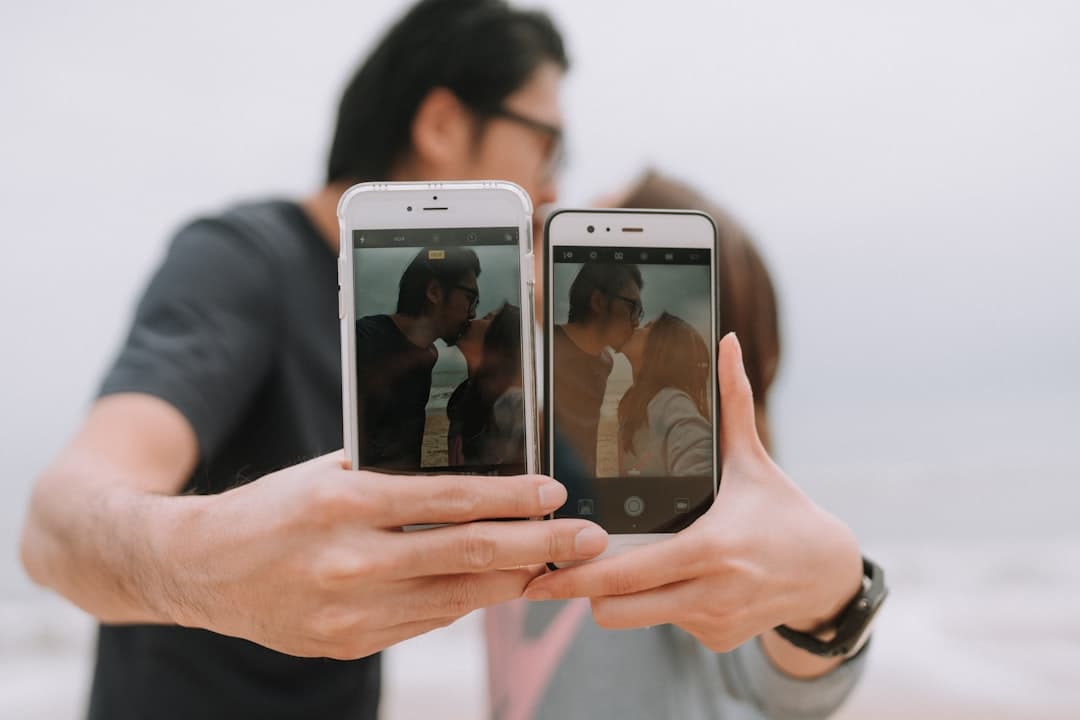
Almost every long distance relationship app on the market was designed for couples who share a kitchen. That is the quiet problem behind most of them. The daily prompt fires at 9am local time and lands at 3am for your partner. The "date night" feature assumes you can both sit down at eight o'clock. The streak breaks because your Tuesday ended while theirs had not started.
This is not a ranked list of fifteen apps. We already did that in our guide to apps for couples in long distance relationships, and if you want app-by-app reviews, start there. This post covers what those articles skip: how your specific time gap determines which app can possibly work, what the research says about whether any of this helps, and a ten-minute test that tells you more than any review.
Table of contents
- Start with your time gap, not the App Store
- What a long distance relationship app has to do that a couples app doesn't
- The countdown is doing more work than you think
- Does any of this actually help?
- What no app can fix
- The ten-minute install test
- What these apps cost in 2026
- Common questions
- Where to start tonight
Start with your time gap, not the App Store
The number of waking hours you actually share is the single best predictor of which features will work for you. Below is that number, calculated for a 7am to 11pm waking day on both sides.
| Time gap | Shared waking hours | What it means for your app |
|---|---|---|
| 0 to 2 hours | 14 to 16 | Almost anything works, including live features |
| 3 hours | 13 | Real-time play is fine; evenings still line up |
| 5 to 6 hours | 10 to 11 | One clean overlap window, usually your morning and their afternoon |
| 8 hours | 8, in one block | Live features start failing; async becomes the priority |
| 9 to 12 hours | 8, split into two shrinking blocks | Async only, plus a genuinely useful partner clock |
Two things stand out. First, past an eight hour gap the total overlap stops shrinking but fragments into two awkward slivers at the edges of both your days. At twelve hours apart you still technically share eight waking hours, but they arrive as your early morning and your late evening. Second, these figures include work, commuting, and sleep debt. The realistic free overlap for most couples is a fraction of the number in that column.
So here is the rule that follows. If your gap is under three hours, a real-time feature set is a legitimate purchase. If your gap is five or more, every hour you spend evaluating live video games and simultaneous play is wasted. What you need is an app where both of you can act alone and the app assembles the result.
The notification problem nobody mentions
Most couples apps schedule notifications in the recipient's local time, which sounds correct until you realize both partners then get pinged at different points in a shared cycle. You answer at breakfast. They see it eleven hours later. If the app closes the round at midnight, one of you is structurally always late.
Ask one question before you commit to any app: whose day is it? Good long distance apps anchor the couple's day to one shared time zone so the same question is live for both of you and a streak cannot break because of the date line. FeelClose does this deliberately, anchoring each couple to a single day boundary rather than letting two calendars fight. It is an unglamorous detail that decides whether the app is still installed in a month.
What a long distance relationship app has to do that a couples app doesn't
A long distance relationship app needs four things that general couples apps rarely ship: asynchronous interaction, your partner's local time, a visit countdown, and passive presence on your home screen. Everything else is a bonus.
Asynchronous by construction. Not "you can also use it async." The core loop should complete correctly when the two of you are never awake at the same time. The test: can one of you answer today, the other answer tomorrow morning, and the reveal still land as a moment rather than a stale notification? Apps built around a shared live session fail this immediately.
Your partner's current time, where you already look. Not a world clock buried in settings. Visible on the home screen or a widget, so you stop doing arithmetic before every call and stop texting into their 4am.
A visit countdown. More on why this matters below. For now, note how many well reviewed couples apps have nothing resembling one, because their target user drives home to their partner every evening.
Something to do together, not just something to say. There are nights when neither of you wants to be profound and a deep prompt feels like homework. Shared games you can play from different cities cover the evenings when a question would fall flat.
What general couples apps ship instead is instructive: structured therapy-style courses, shared grocery lists, chore splitting, and date night planners. All useful for cohabiting couples. All close to worthless when there is a plane ticket between you. If you want the wider category map, our breakdown of what a relationship app actually is sorts the six types and who each one suits.
The countdown is doing more work than you think
A visit countdown is not decoration. Anticipation of a positive event produces more intense emotion than remembering the same event afterwards, a finding replicated across five experiments in Van Boven and Ashworth's research published in the Journal of Experimental Psychology: General. Looking forward hits harder than looking back.
That is a strange and useful fact for a long distance couple. It means the four weeks before a visit are not dead time you have to endure. They are, emotionally, the most charged part of the cycle, and a countdown on your home screen converts a vague ache into a specific number that keeps producing that charge every time you glance at your phone.
The relationship research points the same direction. Long distance couples who have clarity about when the distance ends report higher relationship satisfaction and less distress than couples who cannot see a path to being in the same place. Certainty about the future is not a small thing. It is arguably the variable.
Which leads to the honest caveat. A countdown with no date in it is worse than no countdown at all, because an empty field is a daily reminder that you have not had the conversation. If you do not have a reunion date yet, put a placeholder on the calendar and treat it as a decision to make rather than a fact to wait for. Set the countdown to the next thing you can actually commit to, even if it is a video call you both dressed up for.
FeelClose puts the countdown at the top of the home screen and on an iOS widget, which is the whole point: it should cost you zero effort to see it. The home screen widgets also carry your partner's local time and your days-together counter, so the app registers as a daily touchpoint without you opening anything.
Does any of this actually help?
Yes, modestly, and there is real evidence rather than app store copy. A 2025 systematic review in BMC Psychology pooled trials of digital interventions for couples and found a significant moderate effect on relationship satisfaction, with a combined effect size of Hedges' g = 0.42. That is meaningfully better than nothing and meaningfully worse than good couples therapy.
The most useful app-specific data comes from a 2025 evaluation of the Paired app in JMIR mHealth and uHealth, led by researchers at The Open University and the University of Brighton, covering 745 survey respondents and 440 users tracked over three months:
Users who engaged six or seven days a week scored 11.8% higher on relationship quality than users engaging one day a week or less. And the total time spent in the app during a typical week showed no statistically significant association with relationship quality at all.
That is an association, not proof that frequency is the active ingredient. For a long distance couple, the practical shopping test is whether the app offers a useful interaction that fits the smallest window you regularly share. A longer structured program is not inherently worse if both partners prefer it.
Three caveats belong with those numbers. The sample was self-selected paying subscribers, and there was no control group, so the design cannot prove the app caused the improvement rather than engaged couples being engaged couples. The authors flag both themselves. The third is in the acknowledgements: the study was funded by The Open University with in-kind contributions from Better Half, the company behind Paired. That does not make the findings wrong, and the methodology is more rigorous than anything else in this category. It does mean anyone quoting these numbers without the footnote is selling something.
What no app can fix
An app cannot manufacture physical touch, and it cannot resolve an open-ended separation. Being clear about that is the difference between a tool that helps and a subscription that quietly becomes a source of guilt.
The reunion transition. Research by Stafford and Merolla found that among long distance couples who finally became geographically close, about one third broke up within three months, and the couples who idealized each other most during the separation were the least stable afterwards. No daily question protects you from that. We covered it properly in three harsh facts about long distance relationships.
The absence of an end date. If neither of you can name the year the distance ends, an app will make the drift more comfortable without changing the trajectory. That is a conversation, not a feature.
Insecurity dressed as a feature. Some apps in this category market real-time partner location and activity tracking to long distance couples specifically. Be careful. Surveillance features tend to convert anxiety into monitoring rather than trust, and they escalate. Our guide to long distance relationship trust covers what actually rebuilds confidence when you cannot see each other.
Attention itself. 51% of partnered US adults say their partner is at least sometimes distracted by a phone during conversation, according to Pew Research Center. Adding one more app that wants your attention is not automatically a gift to your relationship. The rule that keeps it honest: the app should produce conversation, not absorb it. If you both answered today's question and never said a word about it out loud, the app did nothing.
And if the problem is bigger than distance, if there is a recurring conflict or a breach of trust underneath it, the American Psychological Association is clear that patterns like that need a trained third party. Start with our guide to couples therapy at a distance instead of an app store.
The ten-minute install test
Reviews cannot tell you whether your partner will keep opening something. This can. Install the app, put ten minutes on a timer, and run these seven checks.
- Time to first shared moment. Count the seconds from install until something actually passes between the two of you. Under two minutes is good. If a personality quiz and a paywall come first, your partner will not survive onboarding.
- Set your partner's time zone. If the app has no place to put it, it was not built for you. Close it.
- Answer today's prompt alone. Does the app hold your answer gracefully until they respond, or does it look broken while it waits?
- Find the day boundary. Ask when the round resets and in whose time zone. If nobody can tell you, expect streak arguments.
- Check the smallest daily unit. Can you engage meaningfully in ninety seconds? If the minimum is a fifteen minute module, the frequency research says you will drift.
- Add the widget. Passive presence costs zero minutes and does more for a long distance couple than any notification.
- Read the permissions. A question and answer app has no business requesting your contacts or continuous location.
Then commit to fourteen days, both of you, anchored to something you already do daily. Not "let's try it." A specific window with a specific anchor. One more thing worth saying out loud: pick for the less enthusiastic partner, not for yourself. Every app in this category is two-player, and a daily question with one answer is just a diary.
What these apps cost in 2026
Prices below are US App Store, checked August 2026. Nearly all of them cover both partners with one subscription, but check, because a few charge per person and quietly double the real cost.
| App | Free tier | Paid |
|---|---|---|
| FeelClose | Countdown, nudges, daily questions, countdown widget, shared pet, 4 of 9 games | $7.99/mo, $49.99/yr, $119.99 once |
| Paired | Limited daily content | $14.99/mo, roughly $40 to $75/yr |
| Connected | Daily questions, check-ins | About $9.99 to $12.99/mo, $77.99/yr |
| Cupla | Full shared calendar | Free |
| Locket | Photo widget | Free, premium around $50/yr |
Before you pay for anything, run two weeks on a free tier with both partners actually engaged. It will tell you more than this table will. Our roundup of genuinely free couples apps compares what each free tier really includes, and our honest review of Paired walks through where the paywall lands.
Common questions
What is the best app for long distance couples?
There is no single answer, because it depends on your time gap. Under three hours apart, most general couples apps will serve you. Beyond five hours, you need an app built around asynchronous play with a partner clock and a countdown, which narrows the field sharply. FeelClose was built for that second case; for a broader comparison see our best couples app rundown.
Do long distance relationship apps actually work?
The evidence says yes, modestly, for couples who use them most days of the week. A 2025 meta-analysis found a moderate effect on relationship satisfaction, and app-specific data shows daily users report noticeably stronger relationships than occasional users. Sporadic use produces little, and one partner using it alone produces nothing.
Is there a good free long distance relationship app?
Yes. FeelClose keeps the countdown, nudges, daily questions, a countdown widget, the shared pet, and four of its nine games free with no time limit. Cupla is free for shared calendars, Locket is free for photo widgets, and Teleparty is free for watching things together. You can build a working stack for nothing.
How many apps should a long distance couple use?
Two or three, maximum. One daily connection app, one way to do something together, and at most one practical tool for scheduling. Couples who install five in an evening hit notification fatigue by day three and delete all of them. More tools do not equal more closeness.
Where to start tonight
Work out your shared waking hours from the table above, then pick the one app that matches that reality instead of the one with the longest feature list. If you are under three hours apart, you have options. If you are eight or more, filter ruthlessly for asynchronous design and stop reading reviews that never mention time zones.
If distance is your situation, download FeelClose free on iOS and send your partner the invite before you overthink it. Set the countdown to your next visit, answer tonight's daily question, and let them find it when they wake up. That gap between your answer and theirs is not a flaw in the design. For couples living eight time zones apart, it is the entire point.
Stay Connected with FeelClose
The relationship app for long distance couples. Countdown to visits, send nudges, answer daily questions, play nine couple games, and raise a little pet together.
Download Free on iOSFeelClose for Android is coming soon
Get an email the day it’s on Google Play.